
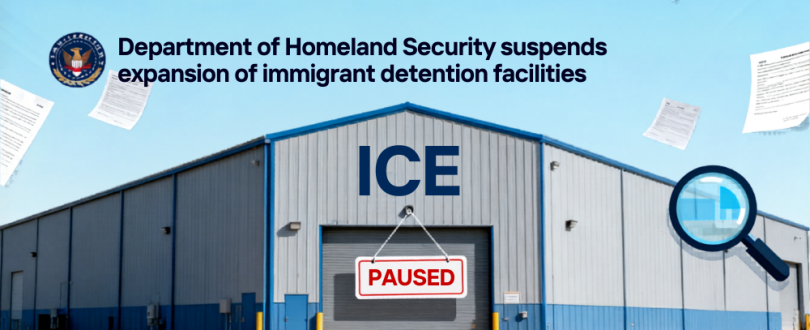
In a move that’s sending ripples through immigration policy circles, the U.S. Department of Homeland Security (DHS) has paused its controversial plan to expand immigrant detention capacity through large-scale warehouse conversions.
The decision follows a leadership shift from Kristi Noem to Markwayne Mullin and signals not a retreat but a recalibration of how the U.S. intends to scale enforcement infrastructure.
Key Takeaways (Quick Summary)
– DHS has paused new warehouse acquisitions for immigrant detention
– Contracts signed under the previous leadership are under review
– The plan aimed to expand detention capacity nationwide dramatically
– Officials emphasize this is a review, not a rollback
– Legal, financial, and community concerns are driving scrutiny
What Is the ICE Warehouse Detention Plan?
Scale of the Expansion
At the center of the controversy is an ambitious plan led by U.S. Immigration and Customs Enforcement (ICE) to scale detention capacity to approximately 92,000 beds—a massive increase from current levels.
The blueprint included:
– 8 mega detention centers, each holding 7,000–10,000 individuals
– 16 regional processing hubs to support intake and deportation logistics
This wasn’t incremental growth. It was a structural transformation of detention capacity—industrial in both design and intent.
Why Warehouses?
Warehouses were seen as a strategic shortcut:
– Faster to convert than building facilities from scratch
– More cost-efficient in the short term
– Easier to standardize across multiple locations
The shift also hinted at a broader policy evolution—from fragmented detention systems to a centralized, high-volume enforcement model designed to support faster removals.
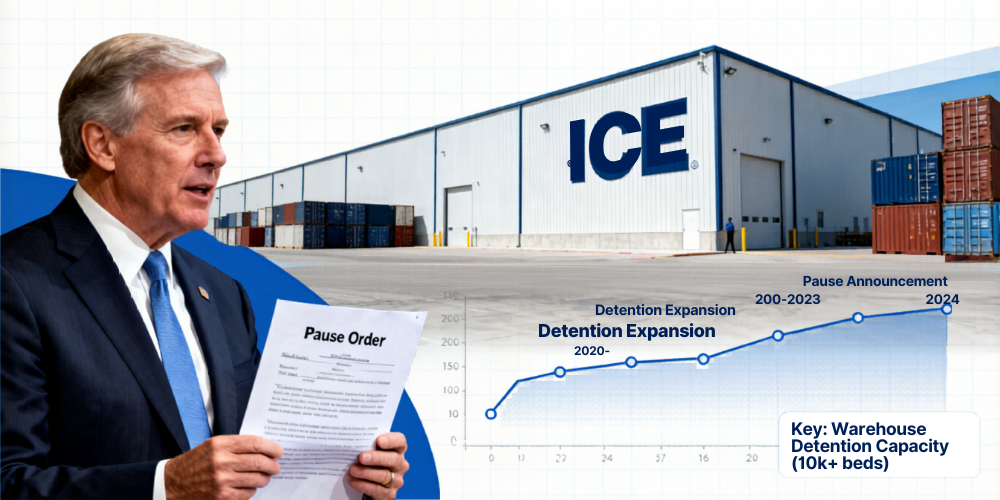
Why DHS Paused the Plan
Leadership Transition
The pause comes in the wake of a leadership change at DHS. With Markwayne Mullin stepping in, a full review of policies enacted under Kristi Noem is underway.
This kind of reassessment is standard during transitions—but the scale and speed of this plan made it particularly vulnerable to scrutiny.
Contract and Oversight Concerns
Beyond leadership optics, the deeper issue lies in contract integrity and transparency.
DHS has initiated a review of:
– Existing warehouse purchase agreements
– Pending acquisition deals
– Procurement processes and vendor relationships
Officials have acknowledged that some contracts may not have undergone sufficient oversight—raising red flags in both legal and policy circles.
What Has Already Happened So Far
Warehouses Already Purchased
Despite the pause, the plan is already partially in motion:
– 11 warehouse facilities have been acquired
– More than $1 billion has reportedly been spent
These sunk costs complicate any attempt at a full reversal. The question now isn’t whether the plan existed—it’s how much of it will survive.
Ongoing Legal and Operational Challenges
The rollout has not been smooth:
– Multiple lawsuits have been filed at the state level
– Some projects have been halted or scaled back due to legal pressure
– Local governments have challenged both the speed and opacity of approvals
In some cases, proposed facilities were downsized after intense public backlash, revealing friction between federal authority and local governance.
Local Backlash and Community Resistance
Infrastructure Concerns
Communities targeted for these mega-facilities have raised practical concerns:
– Can local water systems support thousands of additional residents?
– Are sewer, healthcare, and emergency services equipped to scale?
For many municipalities, the answer is no, and they’re pushing back accordingly.
Political and Public Opposition
Resistance isn’t limited to advocacy groups. It spans:
– City councils and local officials
– State-level policymakers
– Residents are concerned about the economic and social impact
Even in regions that traditionally support stricter immigration enforcement, the scale of these facilities has proven controversial.
Policy Implications: Is This a Slowdown or Just a Reset?
Not a Full Reversal
Let’s be precise: this is not a rollback of enforcement policy.
DHS remains committed to expanding detention capacity. What’s changed is the execution strategy—not the end goal.
The pause is best understood as a tactical reset, allowing the agency to:
– Reevaluate contracts
– Address legal vulnerabilities
– Improve public and political buy-in
Shift Toward Community Engagement
Under Markwayne Mullin, there’s a stated emphasis on working more closely with local stakeholders.
That could mean:
– More transparent planning processes
– Greater coordination with local governments
– Adjustments to facility size and location
Whether this leads to meaningful change—or simply smoother implementation—remains to be seen.
What Happens Next?
Possible Outcomes
Several scenarios are now in play:
– Modified rollout with fewer or smaller facilities
– Delays in construction and operational timelines
– Renegotiation or cancellation of problematic contracts
What to Watch
Key signals to monitor in the coming months:
– Results of the DHS contract review
– Court decisions on pending lawsuits
– Congressional response and funding allocations
These factors will determine whether the plan evolves—or stalls.
Big Picture: The Future of U.S. Immigration Detention
This moment reflects a broader shift in U.S. immigration policy:
– Movement toward large-scale, centralized detention systems
– Increasing tension between federal enforcement and local autonomy
– Growing legal scrutiny over detention practices and infrastructure
The trajectory is clear: enforcement is expanding—but the pathway is becoming more contested.
Conclusion
The DHS decision to pause its ICE warehouse expansion marks a critical inflection point.
The U.S. is not stepping back from strict immigration enforcement. Instead, it’s recalibrating how that enforcement is built and sustained—balancing speed with scrutiny, and ambition with resistance.
What comes next will shape not just detention policy, but the broader architecture of U.S. immigration enforcement for years to come.
FAQ Section
Why did DHS pause the ICE warehouse plan?
To review contracts, address oversight concerns, and reassess implementation following a leadership change.
How many detention centers were planned?
The plan included 8 mega-centers and 16 regional processing hubs.
Are existing detention centers affected?
No—current facilities remain operational. The pause applies to new acquisitions and expansion plans.
Is the U.S. reducing immigration enforcement?
No. Enforcement remains a priority; the pause is about execution, not policy direction.
What role do local communities play in these decisions?
An increasing one. Local resistance, infrastructure limits, and legal challenges are now major factors in how federal detention projects move forward.


