
In a week dominated by debates over border policy, visa backlogs, and enforcement rules, one immigration story stood out for a different reason.
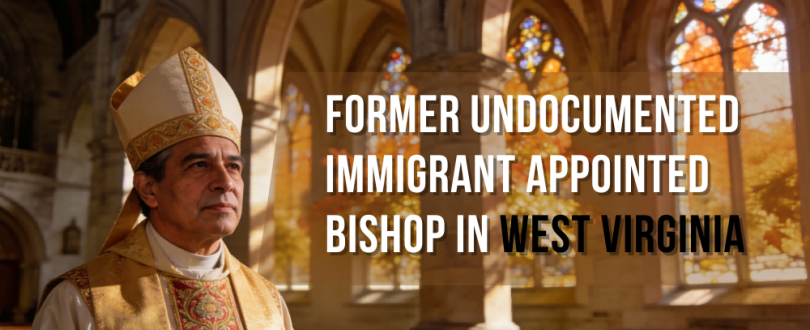
Evelio Menjivar-Ayala, once an undocumented immigrant from El Salvador, was appointed bishop of the Roman Catholic Diocese of Wheeling–Charleston in West Virginia.
The appointment drew national attention because it landed at a moment when immigration remains one of the most contested political issues in the United States. It also carried symbolic weight: a former undocumented immigrant rising to one of the highest leadership roles in the Catholic Church in the state.
Who Is Evelio Menjivar-Ayala?
Evelio Menjivar-Ayala was born in El Salvador and came to the United States as a young immigrant during a period of conflict and instability in his home country.
Like many immigrants arriving during that era, his journey was shaped by uncertainty, legal vulnerability, and the search for safety and opportunity.
Over the years, he entered the priesthood and built a reputation as a pastor deeply engaged with immigrant communities. His ministry often focused on families navigating displacement, legal insecurity, and social integration.
Before this latest appointment, he served in church leadership roles connected to immigrant outreach and pastoral care.
Why This Appointment Matters
This is not simply a church leadership announcement.
It matters because immigration conversations in 2026 are increasingly framed around enforcement, detention capacity, border controls, and security vetting. Public discussion often reduces immigrants to policy categories—visa holders, asylum applicants, undocumented entrants, and deportation statistics.
The appointment of Evelio Menjivar-Ayala introduces a different lens.
It reminds observers that immigration stories unfold over decades. They include long-term integration, civic participation, community leadership, and institutional contribution.
For many advocates, the symbolism is significant: someone who once lived with uncertain legal status now holds moral and public authority in a prominent religious institution.
Immigration and the Catholic Church
The Catholic Church has long been active in immigration debates in the United States.
Catholic dioceses, charities, and community ministries frequently provide legal assistance, refugee support, humanitarian aid, and family services to newcomers. Church leaders have also repeatedly argued for immigration systems that combine border management with humanitarian protection and family unity.
That broader institutional context helps explain why this appointment resonated beyond church circles.
For immigration observers, it became part of a larger conversation about belonging, integration, and what long-term immigrant participation can look like in American public life.
Why It Is Especially Notable in West Virginia
The appointment also carries regional significance.
West Virginia is not usually at the center of national immigration narratives. The state is more commonly associated with debates over economic transition, demographic change, and rural community development.
A bishop with an immigrant background there therefore stands out.
It reflects how immigration is not confined to major gateway cities such as New York City, Los Angeles, or Miami. Immigrant communities increasingly shape social and civic life across a much wider geography.
What This Means for Immigration Conversations in 2026
This appointment does not change immigration law.
It does not alter visa rules, border procedures, or enforcement priorities.
What it does change is the public frame.
At a time when immigration headlines often focus on regulation and enforcement, this story highlights the human dimension of migration—how individuals can move from vulnerability to leadership over time.
That is why it became one of the most discussed immigration-related developments this week.
Final Thought
Immigration debates often center on immediate political pressure. But stories like the appointment of Evelio Menjivar-Ayala show another reality.
Migration is not only about entry. It is also about belonging, contribution, and the long arc of social inclusion.
For that reason, this was more than a church announcement. It became a notable immigration story in America this week.
FAQ
Who is Evelio Menjivar-Ayala?
He is a Catholic bishop originally from El Salvador who previously lived in the United States as an undocumented immigrant.
Why is his appointment important?
It highlights immigrant integration and leadership during a period of intense national immigration debate.
Where was he appointed bishop?
He was appointed bishop of the Roman Catholic Diocese of Wheeling–Charleston in West Virginia.
Does this affect U.S. immigration policy?
No. The appointment has symbolic and social significance rather than legal effect.
Why did this become immigration news?
Because it offered a human-centered immigration story at a time when most headlines focus on enforcement and border policy.


